
by Brian Nunez
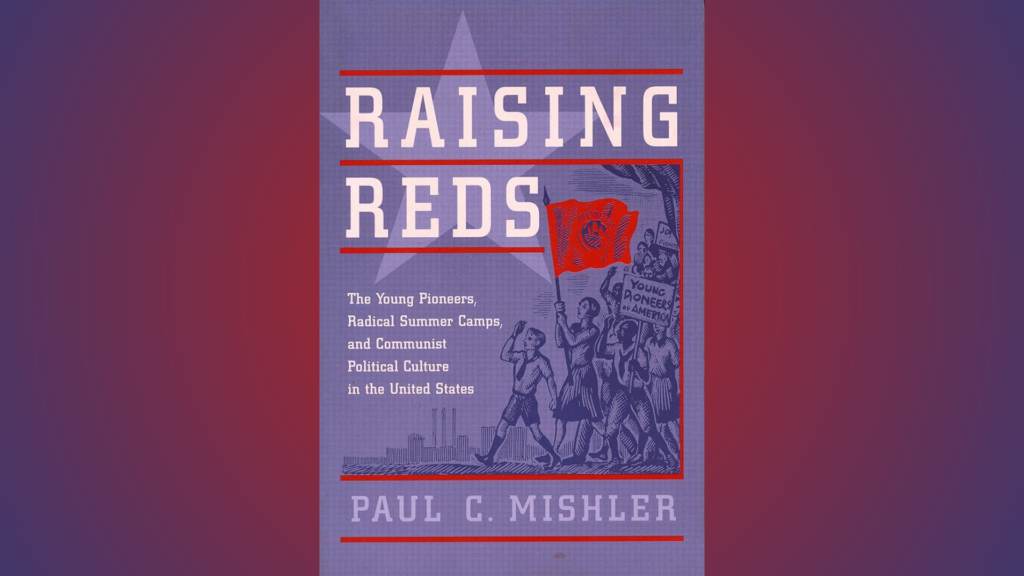
Paul Mishler wrote a fascinating book, Raising Reds, about children being brought up by members of the Communist Party in America. This book offers a valuable historical study of how American communist, and the Communist Party (CPUSA) made efforts in the early 20th century to organize and educate working class youth in summer camps, and young people’s organizations. Raising Reds provides us with an opportunity to analyze successes and weaknesses in how we influence young people today. Mishler provides a detailed account of the CPUSA’s social activities.
In the Author’s introduction, there was a discussion of the Party’s strategy in connecting with foreign born workers to communist ideology. Mishler analyzes how the Party meshed ethnic and cultural identities with a foundation in the working-class struggle.
Capitalism, as a system of exploitation, is the main force that oppresses all workers, regardless of their national origin, gender, race, or cultural background. Immigrant workers are particularly vulnerable to exploitation by Capital. Thus is why it is important to unite them based on their common class interest which is the chain that connects the entire working class. The party emphasized class unity, not at the expense of cultural autonomy; Ethnic pride is great but could never be a substitute for building the revolutionary consciousness needed to wage a class struggle. He romanticizes ethnic identities and cultural forms suggesting that utopianism and idealism particularly strong from the radical European immigrants to America is what advances the movement. Suggesting the ideas of people is what moves history forward not the contradictions between our mode of production and mode of distribution, as well as the class struggle with the active participation and intervention of the masses. As Marx and Lenin taught us, class consciousness must transcend national and cultural divides if the working class is to effectively organize itself. As Marxist, we understand that the oppression of immigrant workers was not simply a result of their ethnic identity but a product of the capitalist systems need to exploit vulnerable populations.
Mishler succeeds in recognizing the importance of Education and organization of the youth is an integral part of the present and future of the movement; though he views it as important because it keeps the dream and ideal of socialism alive for its construction in the future. He misunderstands what was the real goal of these organizations. Mishler describes how the CPUSA used artistic expression and cultural activities as a means of fostering solidarity and a love for our Communist heritage. He gives special attention to the role of songs, plays, and visual art in the education of youth. This, of course, is in line with the long-standing Communist tradition of using culture as a weapon in the ideological struggle as well as to get people immersed in the movement and lift morale. He at times romanticizes these activities and trivializes their purpose. He overlooks the need for a strict disciplined Marxist-Leninist education to combat the many obstacles on the path to socialism that require a disciplined party and leadership to walk the tightrope. Although it’s great for the youth to be excited to build a better future it’s not enough to be shown vague references of “revolution” or “justice”. It is essential We equip the youth with the tools of dialectical materialism, teaching them to understand the world scientifically and to engage in the class struggle as conscious actors in history. They must learn from history, not as a set of dogmatic lessons, but as a living dialectic.
Mishler’s recognition of the cultural front as an important battleground is correct, but his view of the cultural front as taking precedent over everything is quite a mistake. Culture can be a progressive force and tool to advance the interest of the masses, but this can only be utilized for the interest of the working class and not against them by the bourgeois with a disciplined party led by the most disciplined and tested leaders of the working class. In every country where socialism triumphed, the progressive parts of culture and the revolutionary history of a nation have been exemplified and wielded for progress. Mishler provides great detail and sources, but he fails to grasp the significance of these cultural efforts.
If you are interested in joining the League of Young Communists USA or Party of Communists click here: https://partyofcommunistsusa.net/pcusa-candidate-application/

Pingback: Raising Reds Review, Pt 2 - The Worker
Pingback: Raising Reds Review, Pt 2 - League of Young Communists USA