
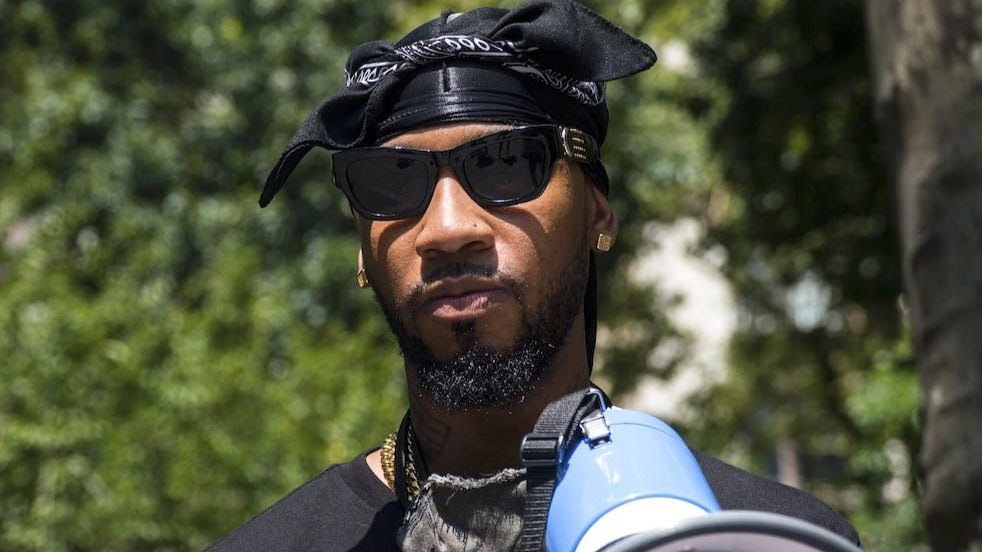
By Driss El-Hassan
Earlier this month, Jacobin’s Annie Levin contributed an article for the democratic-socialist publication titled “The Rise and Fall of Chris Smalls.” The former President of the Amazon Labor Union (ALU) has been a topic of contentious discourse on the left in recent years, both within the labor movement and the left at large. The tactfulness of this polemic and the issues Levin seems to have with Smalls, however, should be analyzed critically.
Levin starts by giving context on Chris Smalls’ rise in notoriety as a labor leader, and highlights how Smalls, through his participation in the organizing drive at Amazon’s JFK8 fulfillment center, became a figure whose ineluctable presence in the US labor movement garnered the charisma and leadership the ALU needed to amass community support. Levin even went so far as referring to Smalls as a “celebrity,” a term that implicates Smalls as someone who’s career is at least partially oriented around fame and a solid public relations campaign.
Subsequently, the following passage reads:
“[Smalls’] flashy personal style, pairing gold grills and chains with union merchandise and political streetwear, transformed the ALU into something like a fashion brand. Like a music act, Smalls and his ALU cohort toured the country, spreading the good news of worker organizing to Amazon warehouses and university campuses. In New York City in 2022, I saw him numerous times pull up to picket lines in a convertible, decked out head to toe in eye-catching ALU union drip.”
One cannot help but acknowledge the elephant in the room: the astonishingly flagrant and shameless display of racism Levin didn’t even bother trying to mask.
Smalls, contrary to Levin’s posturing, gained notoriety throughout the ALU campaign for a variety of reasons, including but not limited to his outreach within and outside of labor, his public speaking skills, and his ability to clearly and effectively articulate the aims and values of the ALU campaign and its membership.
The comparison of the ALU under Chris Smalls to that of a “fashion brand” is not only dehumanizing to Smalls, but it reduces the work of the ALU campaign to enigmatic, shallow aesthetics as opposed to a tangible force within labor to gain concessions for its members, victims of one of the most abusive multinational corporations to scour the face of the earth. To say that Smalls’ “drip” had any bearing on the legitimacy of the ALU as a union is intensely bigoted.
Whether or not Smalls wears gold chains, grills, or “political streetwear” is not a measure of Smalls as a union organizer or the ALU as a legitimate representative of Amazon workers and their capacity to collectively bargain with and curtail the power of monopoly capital. If Levin had referred to Smalls using the N-word, not only would their hit-piece be much more concise, but it would spare the reader the disrespect of having to endure their thinly-veiled, exhaustive attempt to hide their contempt for black people in positions of power within the working-class movement.
Levin’s remarks objectively obfuscate the aim of the working class for cultural and ethnic diversity within organized labor. Their careless rhetoric contributes to dissent amongst workers of different ethnic backgrounds, and creates wedges in the social fabric of the labor movement where there originally weren’t any.
This hit-piece by Jacobin is a sobering reminder of the necessity of Marxism-Leninism to resolve the contradictions within labor driven by capitalism: racism, sexism, homophobia, transphobia, etc. These ideas are not natural products of the American working class but are imposed on us by a system that benefits from our division and a bestial hatred between peoples. Only scientific socialism can secure the kernel of working class resistance against forces both within and outside our movement who aim to maintain ideological impotence within organized labor.
