
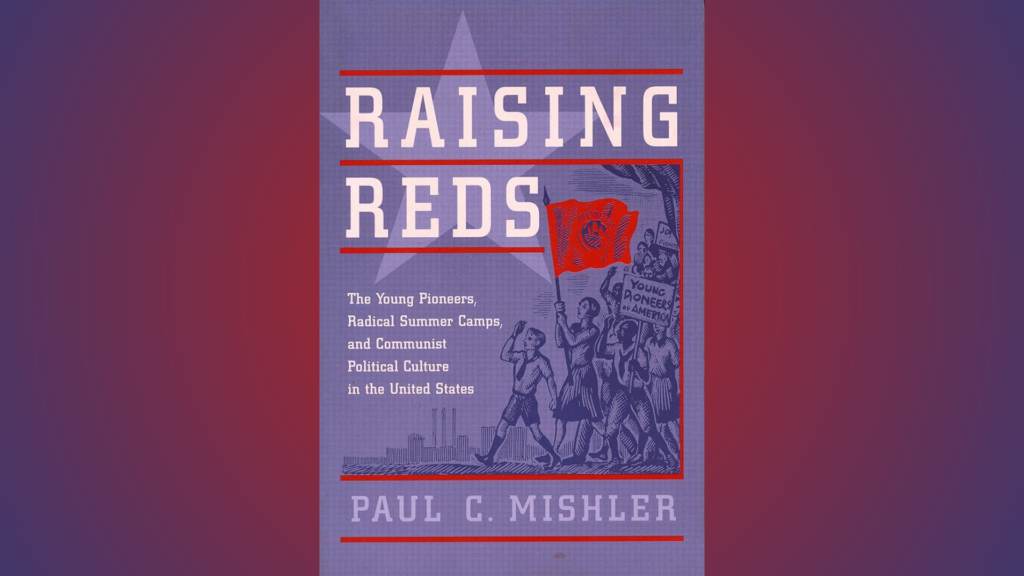
Continuation from Part 1 – Raising Reds Review
In chapter 2 Mishler gives account of the preceding theories on child rearing, education, and family life developed by radicals and communist before and during the time of communism. Bebel and their theory of free love is discussed heavily and how his theory was extremely popular among German socialist because its simple language to express their yearning for a better world. Mishler says “The popularity of ‘women under socialism’ points to the strong connection between the utopian aspirations of socialist and the desire for domestic reorganization” pushing this idea that utopianism and idealism is the “warm current” in all radical movements as he stated earlier in the book, which is a rejection of Marxist theory. Mishler bring up Sunday schools and camps organized by anarchist and socialist before the 1920’s and 1930s and their idealist tendencies and their as he describes “laissez-faire” approach to raising children. When talking about how communist children’s groups were to be political organizations fully integrated into the political structure of the party as well as educationally oriented. The author says this isn’t a rejection of anarchist or socialist educational models but rather the communist attempt at “locating in their children’s organizations their utopian hopes and expectations”. Again, I think it is quite a misunderstanding of the parties goal.
Now Mishler gives us a great account of the Young Pioneers of America (YPA), its structure, and its history. It was the junior section of the Young Workers League, which was the youth arm of the workers’ party. Which between 1922-1925 was the legal face of the “illegal” Communist party. After the party came above ground YPA was a mass org affiliated to the party. The organization mirrored the organization of a communist party, even comparing the school for children to the factory for adults. YPA organized scout clubs, summer camps, walked picket-lines, setup ad hoc organizations for children of strikers.
Mishler again brings up the Strategy of the Party and the YPA regarding immigrants and their similarities. Claiming both wanted to be American organizations and deemphasized their immigrant character. Again, this is an oversimplification of the party initiative, and I think a misunderstanding of this country’s history. The party was attempting to build class unity in the context of the material conditions of the USA. This is a country created by immigrants and that throughout the many struggles in our nation to build a truly free and democratic country immigrants have played an integral and progressive role in our nation’s history. Our National History is an international history where without contributions from nations like France and ideas imported to the USA our history could not be told truthfully. Immigrants and communist here in the USA today have a right to forge a democratic and free nation for the future and learn from the progressive strand of our history like our revolution against feudalism, the efforts of Jefferson, and the struggle against slavery and bigotry. Mishler frames it as if the Communist were against American culture, but to gain influence they began to get their children’s organizations to partake in more “outwardly direct political activities” that have an impact on mainstream American society. This is simply not true as communist we know the ruling class will claim its ideology as the ideology of the people or of the nation; but Bourgeois American culture is not representative of American culture. This country has a long history of militant struggle and of revolutionary struggle that we must emphasize and learn from.
Mishler also speaks highly of the summer camps of the 1930s and 1940s organized by communist and other radicals. Mishler calls the summertime “Utopian season” and praised the so called “vacation resorts” and “utopian experiments”. We should be proud of the historical efforts of our predecessors, especially of camp Wo-Chi-Ca, but we should also try to build from them, improve them and apply them to today. Mishler was more focused on the symbolism, abstract ideas of freedom, the solidarity and community built in these camps as a “reflection of the communist hope for a revolutionary future.” The sense of community and socialist symbolism is great and should be fostered but the emphasis should be on education provided to make sure these children grow up to be good, disciplined militant communist Marxist. The youth is usually energetic and idealistic which can be used for positive. However, this energy must be guided by the disciplined leadership of the party. Left unguided youthful zeal can be easily co-opted by opportunist and counterrevolutionary forces. For this reason, we must make sure the youth are not only enthusiastic about making change but well versed in the theory and practice of Marxism Leninism. Mishler’s view of these summer camps as utopian experiments and romanticization of their “separation” from the rest of the capitalist world seems quite escapist.
Retrieved from the League of Young Communists USA

Pingback: Raising Reds Review Pt.3 - League of Young Communists USA